
 Home > Interpol Notices Types Explained: Legal Guide (2026)
Interpol Notices Types Explained: Legal Guide (2026)
INTERPOL Notices are international law-enforcement alerts issued through INTERPOL’s global network to help member countries:- locate persons;
- share information;
- identify missing individuals;
- warn about potential threats;
- support criminal investigations.
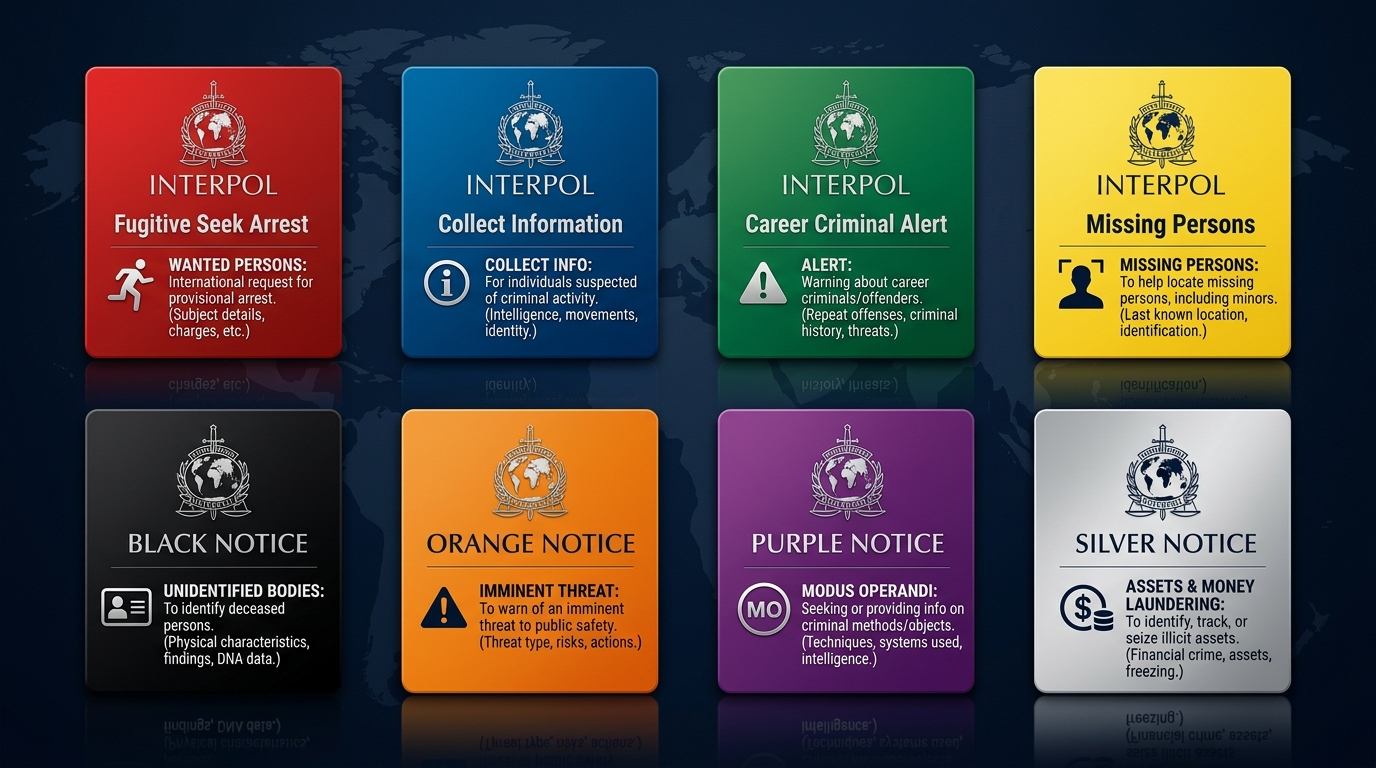
The notice system includes several categories: Red Notice (arrest requests), Blue Notice (location information), Green Notice (criminal warnings), Yellow Notice (missing persons), Black Notice (unidentified bodies), Orange Notice (imminent threats), Purple Notice (criminal methods), and Silver Notice (asset tracing). Each serves a distinct international law-enforcement purpose under the Rules on the Processing of Data. Individuals affected by a notice may consult a Red Notice lawyer, seek notice removal, or challenge data before the CCF.
What are the different types of Interpol notices and their colors?
Interpol operates a color-coded notice system to facilitate cooperation among its 196 member countries. Each notice type addresses a distinct law enforcement need and follows strict criteria established in Interpol’s Constitution and the Rules on the Processing of Data.
Red Notices request the location and provisional arrest of individuals wanted for prosecution or to serve a sentence. Red Notices are not international arrest warrants. Interpol explicitly states that each member country applies its own domestic laws and extradition treaties before taking enforcement action. The notice must be based on a valid national arrest warrant or court decision from the requesting country’s National Central Bureau (NCB).
Blue Notices collect additional information about a person’s identity, location, or activities in relation to a criminal investigation. Law enforcement agencies use Blue Notices when they need intelligence to advance an investigation but do not yet seek arrest. The Blue Notice list is not publicly accessible through Interpol’s website.
Green Notices provide warnings about individuals whose criminal activities pose a possible threat to public safety. These notices alert member countries to repeat offenders who may commit crimes across borders, enabling preventive monitoring without necessarily requesting arrest or extradition.
Yellow Notices help locate missing persons, often minors, or identify persons unable to identify themselves due to medical conditions, accidents, or disasters. Yellow Notices serve humanitarian rather than enforcement purposes and frequently assist families separated by international borders.
Black Notices seek information on unidentified bodies to determine identity and circumstances of death. These notices aid coroners, forensic teams, and missing persons investigations across jurisdictions, helping close cases and provide closure to families.
Orange Notices warn of events, persons, objects, or processes representing serious and imminent threats to public safety. Orange Notices address emerging risks requiring immediate international attention, including terrorist threats or dangerous fugitives.
Purple Notices seek or provide information on modus operandi, objects, devices, and concealment methods used by criminals. These notices share intelligence about criminal techniques to improve investigative capacity across member countries.
Silver Notices identify and trace criminal assets during pilot-phase operations. This notice type remains under development as Interpol refines procedures for international asset recovery cooperation.
How does Interpol issue and process notices?
Notices are international requests for cooperation or alerts published at the request of a member country’s National Central Bureau (NCB). Each notice must comply with Article 2 and Article 3 of Interpol’s Constitution. Article 3 strictly prohibits intervention or activities of a political, military, religious, or racial character.
The requesting NCB submits detailed information supporting the notice request. Interpol’s General Secretariat in Lyon, France reviews each submission for compliance with the Rules on the Processing of Data before publication. This review examines whether the notice serves a legitimate law enforcement purpose and respects fundamental human rights.
Notices circulate through Interpol’s secure I-24/7 communication system, connecting law enforcement agencies in 196 member countries. When an individual subject to a Red Notice crosses an international border, immigration systems may flag the alert. What happens next depends entirely on the laws of that country—some require immediate judicial review, others permit provisional detention pending extradition proceedings.
Member countries report notice “hits” back to the requesting NCB through Interpol channels. The requesting country must then initiate formal legal proceedings, such as extradition requests, through diplomatic or judicial channels. Interpol facilitates communication but does not conduct investigations or make arrests itself.
How serious is an Interpol Red Notice and what are the consequences?
A Red Notice carries significant consequences for the subject. While not an arrest warrant, it functions as a global alert that law enforcement worldwide uses to identify wanted individuals. The practical effect resembles an international wanted poster distributed to border control, police, and security agencies in all 196 member countries.
Individuals subject to Red Notices face arrest risk when crossing international borders. Countries with extradition treaties with the requesting state may detain the person provisionally while extradition proceedings commence. Detention can last months depending on the jurisdiction’s legal processes and whether the individual challenges extradition.
The European Court of Human Rights examined Red Notice consequences in cases including M.K. v. France (application number 34349/18). The Court found that member countries must conduct effective individual review of Interpol data rather than automatically relying on notices, recognizing that Red Notices engage Article 8 rights to private life and potentially Articles 5 and 13 of the European Convention on Human Rights.
Red Notices also create practical difficulties beyond arrest risk. Financial institutions conducting enhanced due diligence may freeze accounts upon discovering a client’s Red Notice status. Employment background checks, visa applications, and professional licensing processes can fail when a Red Notice appears. Travel becomes severely restricted as individuals avoid countries likely to enforce the notice.
The notice remains active as long as the underlying national arrest warrant or judicial decision remains valid in the requesting country. Interpol reviews notices periodically, but removal typically requires either withdrawal by the requesting country, successful challenge through the Commission for the Control of Interpol’s Files (CCF), or compliance review by the General Secretariat finding Article 3 violations.
What is a Purple Notice and what is a Black Notice from Interpol?
Purple Notices and Black Notices address specialized law enforcement needs distinct from person-focused alerts like Red or Blue Notices.
Purple Notices share intelligence about criminal methods, objects, devices, and concealment techniques. When investigators discover a new smuggling method, fraud scheme, or technical device used by organized crime, a Purple Notice disseminates this information to all member countries. This knowledge-sharing helps law enforcement agencies recognize emerging threats and adapt investigative techniques.
For example, when cybercriminals develop a novel malware variant or money launderers create a new layering technique, Purple Notices provide technical details enabling other countries to detect and counter these methods. The notice includes descriptions of modus operandi, device specifications, and forensic indicators law enforcement should recognize during investigations.
Black Notices serve humanitarian identification purposes. When authorities find unidentified human remains, a Black Notice circulates descriptions, forensic data, and circumstances to all member countries. The notice may include DNA profiles, dental records, physical descriptions, clothing, and location details.
Black Notices help solve missing persons cases spanning multiple countries. A family searching for a relative who disappeared abroad may find answers when a Black Notice matches missing person reports. These notices also assist disaster victim identification following aviation accidents, natural disasters, or mass casualty events with international victims.
Neither Purple nor Black Notices request arrest or detention. They facilitate information exchange supporting investigations and humanitarian identification rather than fugitive apprehension.
Can you challenge or remove an Interpol notice?
Individuals may challenge Interpol notices through the Commission for the Control of Interpol’s Files (CCF), an independent body established under Interpol’s Constitution and governed by the CCF Statute and Operating Rules.
The CCF reviews whether notices comply with Interpol’s Rules on the Processing of Data and Article 3 of the Constitution. Applicants must demonstrate that the notice violates Interpol’s rules, lacks legal basis in the requesting country, or represents prohibited political, military, religious, or racial intervention.
Challenges follow a structured procedure with specific deadlines. The CCF acknowledges requests within fixed timeframes specified in its Operating Rules, then conducts admissibility assessment and merits review. Applicants must provide detailed evidence supporting their claims, including legal analysis, documentation of procedural violations, and proof of political motivation where applicable.
Common grounds for successful challenges include political persecution claims under Article 3, procedural defects in the underlying national warrant, violations of fundamental human rights standards, and lack of dual criminality where the alleged conduct is not criminal in most member countries.
The CCF may order Interpol to delete the notice if it finds violations. Deletion removes the notice from all Interpol systems immediately, and member countries must remove corresponding data from their national databases. The CCF publishes anonymized summaries of decisions establishing precedents for future cases.
Requesting countries may also withdraw notices voluntarily. When criminal proceedings in the requesting country conclude through acquittal, sentence completion, or prosecutorial decision not to proceed, the NCB should withdraw the corresponding notice. Legal representatives may negotiate withdrawal by addressing concerns with the requesting country’s authorities directly.
National courts in many jurisdictions provide additional remedies. Under Directive 2016/680 on data protection in law enforcement, European Union member states must allow individuals to challenge law enforcement data processing, including data received from Interpol. National data protection authorities and courts can order removal of Interpol notice information from domestic systems even when the notice remains in Interpol’s database.
What legal protections exist for individuals subject to Interpol notices?
Individuals subject to Interpol notices hold rights under both Interpol’s internal rules and applicable human rights law. These protections have strengthened significantly since 2010 following high-profile cases of abuse.
Interpol’s Rules on the Processing of Data require notices to respect fundamental human rights as reflected in the Universal Declaration of Human Rights and regional human rights instruments. The rules mandate that notices serve legitimate law enforcement purposes, contain accurate information, and undergo regular review for continued validity and compliance.
The European Court of Human Rights examines Interpol notices under Article 8 of the European Convention on Human Rights (right to private life). Courts recognize that Red Notices affect reputation, movement, and private life significantly enough to require justification under Article 8(2). National authorities must conduct individual assessments rather than automatically enforcing Interpol alerts.
Regulation 2016/794 on Europol governs data exchange between Europol and third countries including Interpol. The regulation requires data quality safeguards, purpose limitation, and individual rights protection when EU law enforcement agencies process Interpol data.
National courts in common law jurisdictions increasingly scrutinize Red Notice-based arrests. Courts in the United Kingdom, Canada, and Australia require independent judicial review of extradition requests even when supported by Red Notices, examining whether extradition would violate fundamental rights or fair trial guarantees.
The right to request access to Interpol data allows individuals to discover whether they are subjects of notices. Under CCF procedures, any person may submit an access request to learn what information Interpol holds about them. This transparency mechanism enables individuals to challenge notices they did not know existed.
Facing an Interpol notice or Red Notice challenge?
Our independent legal team specializes in CCF deletion requests, political persecution defences, and cross-border notice challenges. We work with clients across all 196 member countries to remove unlawful alerts and restore freedom of movement. Review our Interpol notice defence services or arrange a confidential consultation to assess your options.
This article is published by an independent law firm for informational purposes only and does not represent or claim affiliation with any government body, international organization, or official authority.
Frequently Asked Questions
What types of Interpol notices exist?
Interpol issues eight notice types: Red (arrest requests), Blue (information collection), Green (criminal warnings), Yellow (missing persons), Black (unidentified bodies), Orange (imminent threats), Purple (criminal methods), and Silver (asset tracing). Each serves distinct law enforcement or humanitarian purposes under the Rules on the Processing of Data. Additionally, Diffusions function as informal alerts with similar enforcement effects.
What is the most serious Interpol notice?
The Red Notice is the most serious Interpol notice. It requests member states to locate and provisionally arrest a named individual pending extradition. A Red Notice can trigger immediate detention at borders and airports in any of Interpol’s 196 member countries. If you are subject to a Red Notice, the priority is to challenge it through the Commission for the Control of Interpol’s Files (CCF) while reviewing extradition exposure.
Can Interpol notices be challenged or removed?
Yes. Any Interpol notice that does not comply with Interpol’s Constitution, Rules on the Processing of Data, or human rights standards can be challenged through the CCF. Common grounds include political motivation, dual criminality failure, procedural defects, and human rights risk. The CCF review process typically takes 9–18 months. In some cases, direct engagement with the issuing member state is also effective.
What is an Interpol Diffusion?
A Diffusion is a direct message sent by a member state to selected other member states through Interpol’s secure I-24/7 network. Unlike formal notices, Diffusions are not subject to Interpol General Secretariat approval before transmission. Despite this, they can produce the same practical enforcement effects as a Red Notice, including border detention. They are also harder to discover as they are not published on Interpol’s public website.