
 Home
HomeInterpol Blue Notice

IIf you’ve heard the term and aren’t quite sure what it means — or you’re worried one might have been issued against you — this guide is for you. We’ll walk through what it actually is, who ends up on the receiving end, what happens next, and how it can be challenged..

What is an INTERPOL Blue Notice?
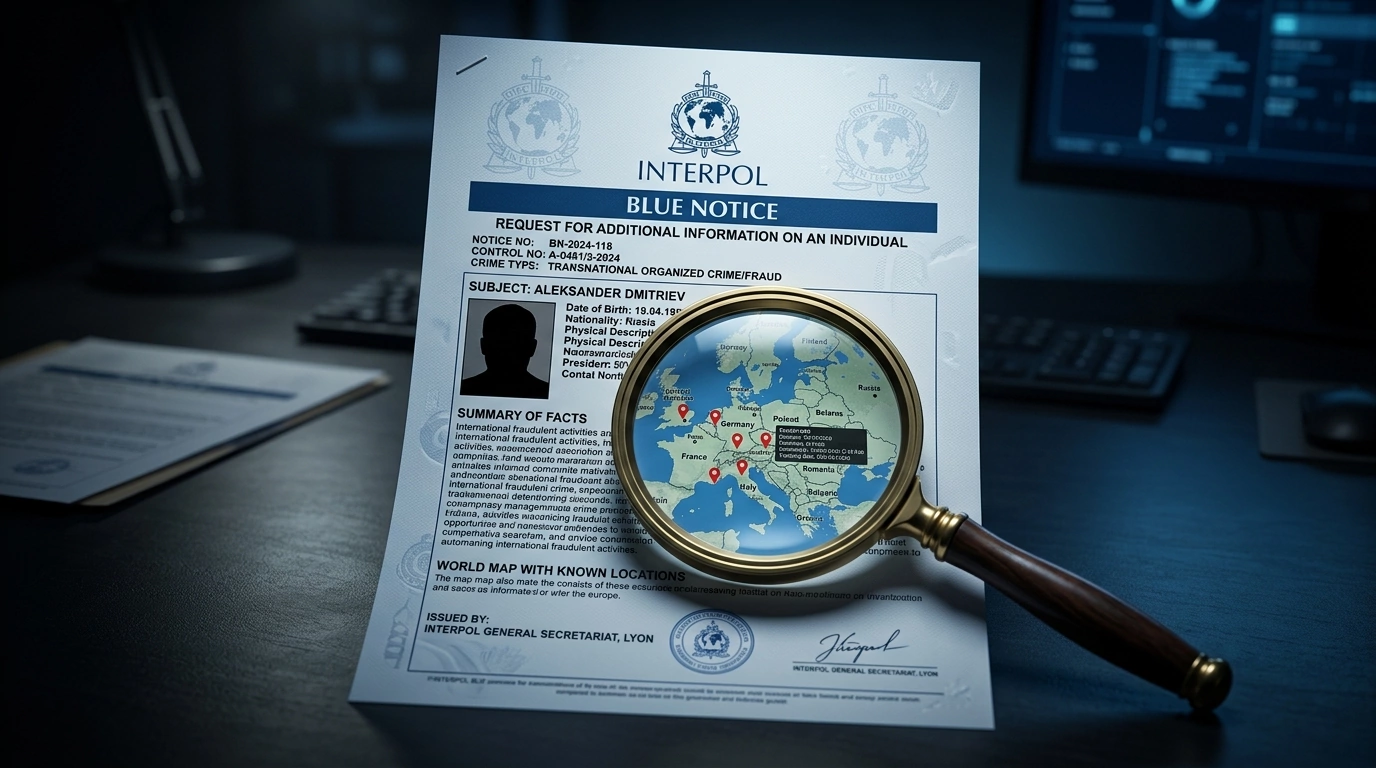
A Blue Notice is an international alert used to help law-enforcement authorities obtain information about a person’s identity, location, or activities in connection with a criminal investigation.
It’s not an arrest warrant. It’s an information-gathering tool — nothing more. When law enforcement in one country needs details about a person’s identity, whereabouts, or activities in connection with an ongoing investigation, they can request that INTERPOL circulate the alert to member states. Other countries’ agencies then check their databases and report back whatever they find.
This differs significantly from a Red Notice, which is essentially an international request to locate and provisionally detain someone. Other alert mechanisms include Green, Yellow, Orange, Purple, Black, Silver, Diffusions, and UN Special Notices, each serving a different law-enforcement purpose. This one is about collecting information — not making arrests. That said, its existence isn’t consequence-free. It can lead to heightened scrutiny at borders, complicate travel, and damage reputation, even when no charges have been filed.
Who Gets a Blue Notice Issued Against Them?
The range is broader than many people assume. Notices are issued for suspects whose location is unknown or who may be travelling under a false identity; for witnesses who have gone out of contact and hold information critical to a case; for missing persons where there are grounds to suspect criminal involvement, such as trafficking or abduction; and for individuals connected to transnational financial crimes – fraud, corruption, money laundering – where investigators are trying to map out a network.
It’s worth noting that being on the Interpol Blue notice list doesn’t mean you’ve been charged with anything. In many cases, the requesting country simply needs to locate someone to ask questions.
How the Blue Notice Process Works
The process begins when a member state’s National Central Bureau (NCB) submits a formal request to the General Secretariat. That request has to contain identifying information, a photograph where available, and a clear explanation of why it’s needed. Before anything is published, the request is checked against INTERPOL’s own rules — notices cannot be issued for political, military, racial, or religious reasons. If it passes that check, it enters the secure system and becomes accessible to law enforcement worldwide.
From there, agencies in member countries can check their own records and contribute any relevant findings back to the requesting NCB. One detail worth knowing: these alerts can be updated. As new information surfaces — travel routes, contacts, alias documentation — the record is amended accordingly. This makes it a live investigative tool, not a static one.
Commonly used in investigations involving:
- fraud and financial crime schemes;
- tax evasion and offshore asset concealment;
- money laundering;
- drug and human trafficking;
- crimes against minors;
- organized crime and terrorism-related matters.
Blue Notice vs. Red Notice – The Key Difference
The two are often confused, so here’s a straightforward comparison. A Red Notice is a request for provisional arrest, backed by an actual warrant or court order — if you’re located in another country, local authorities can detain you pending extradition. This one carries no such legal force: no country can arrest you based on it alone. Its function is purely informational — gather data, pass it to the requesting NCB, and leave any further action to the domestic judicial process.
That said, if the information gathered this way eventually supports a stronger case, it can contribute to a formal arrest request down the line. So while it carries no arrest power on its own, it’s not something to ignore.
| Feature | Interpol Red Notice | Interpol Blue Notice |
|---|---|---|
| Primary Purpose | To seek the location and provisional arrest of a person pending extradition, surrender, or similar legal action. | To collect additional information about a person’s identity, location, or activities in relation to a crime. This is a core function of any Blue notice. |
| Legal Basis for Action | Acts as an international request for provisional arrest, based on a valid arrest warrant or court decision. | Does not have direct legal force for arrest. An Interpol Blue notice serves purely as an information-gathering tool. |
| Typical Crimes | Serious offenses like murder, terrorism, major drug trafficking, war crimes. | A broader range, including economic crimes, fraud, corruption, and locating witnesses or missing persons. |
| Outcome if Located | The individual can be provisionally arrested by the law enforcement authorities of the country where they are found. | No arrest is made based solely on a Blue Notice. Authorities provide information back to the requesting NCB. |
Can a Blue Notice Be Challenged?
Yes — and this is where our work begins. Even without arrest powers, a Blue notice can cause real harm: complications at border crossings, damage to professional reputation, and the anxiety of being monitored internationally. If it was issued unlawfully or relies on inaccurate information, there are grounds to fight it through the same Commission that reviews Red Notices and diffusions.
Who Handles Your Case
Your Blue notice case is led directly by a senior partner — not handed off once the filing starts.
Dmytro Konovalenko, Senior Partner and member of the International Association of Lawyers, has taken Blue notice cases to the CCF — including one involving a notice that outlived its original investigative purpose by years.
Two of many — our lawyers work across jurisdictions in parallel, so a CCF challenge, travel guidance, and liaison with the requesting NCB move together instead of waiting on each other.
Concerned About an Interpol Blue Notice? Talk to Us
If you’ve discovered — or suspect — that one has been issued against you, early legal advice matters. The sooner we can assess the situation, the more options are available. We’ll identify whether there are grounds to challenge, what the realistic timeline looks like, and what you should and shouldn’t do in the meantime. Our goal is straightforward: get it removed and protect your rights throughout the process.
- Case Analysis: A thorough review of your situation to identify any rule violations or other grounds for challenge.
- CCF Representation: Detailed legal arguments and supporting evidence submitted to the Commission for the Control of INTERPOL’s Files, seeking deletion or correction.
- Liaison with Authorities: Direct contact with the relevant NCB and other bodies where it can help resolve the matter.
- Preventative Advice & Crisis Management: Guidance on safe travel and managing the practical fallout while the challenge is pending.

FAQs
Is a Blue notice public?
No. Unlike a Red Notice, blue notices aren’t published — you can’t check for one on INTERPOL’s website. Most people only learn of one through a border stop, a visa issue, or direct contact from authorities.
Can I still travel internationally with a Blue notice against me?
It depends on the country and what the notice is being used for. Since it carries no arrest power, most crossings go through without incident — but heightened scrutiny, secondary screening, or questioning are common, and risk varies by jurisdiction.
I’m a witness, not a suspect — can a Blue notice still be issued against me?
Yes. Blue notices are used to locate witnesses and missing persons, not just suspects — being named on one doesn’t mean you’ve been charged with anything.
How long does a Blue notice stay active?
There’s no automatic expiry. It remains in INTERPOL’s system — and gets updated as new information comes in — until the requesting NCB withdraws it or the CCF orders its deletion.