In March 2026, Iran carried out a series of drone oil attacks on the Fujairah oil storage hub — one of the most strategically significant energy terminals in the world, located on the eastern coast of the UAE outside the Strait of Hormuz. The Iran strike UAE oil storage facilities triggered a fire at the terminal, disrupted loading operations, and sent global oil prices surging past $100 per barrel.
The attack is not an isolated incident. It reflects a deliberate escalation strategy targeting Abu Dhabi oil infrastructure and the broader Gulf energy supply chain. With Middle East tensions intensifying and the Strait of Hormuz crisis deepening, understanding what happened in Fujairah — and why — is essential for investors, traders, legal practitioners, and anyone exposed to global energy markets.
Iran Attack on UAE Oil Storage Facilities: What Happened
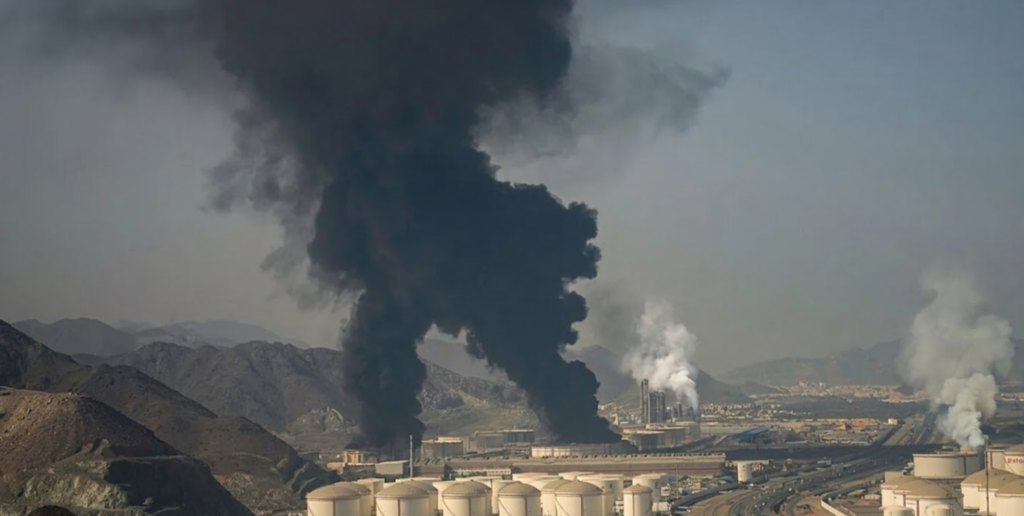
Iranian Shahed-series drones struck the oil storage area in Fujairah in what appears to be a coordinated drone oil attack on commercial energy infrastructure. Key facts confirmed or widely reported at the time of writing:
• A fire broke out in the tank farm area of the Fujairah terminal and burned for several hours before being brought under control.
• Oil loading operations were partially suspended, causing immediate gulf oil supply disruption for tankers already en route to the port.
• Personnel were evacuated from the affected zones; casualty figures were not officially confirmed in full.
• War-risk insurers responded within hours, raising premiums for vessels operating in the region.
The Fujairah oil attack is not without precedent. In May 2019, four commercial vessels — including oil tankers — were sabotaged near the port in what US and UAE authorities attributed to Iran-linked actors. The 2026 strikes represent a direct escalation from sabotage to open drone warfare against fixed oil storage infrastructure.
Why Fujairah Is a Strategic Oil Hub
The significance of the Fujairah oil attack can only be understood in the context of the port’s unique position in global energy logistics. Oil storage Fujairah is not simply a regional facility — it is a structural component of the world’s oil supply architecture:
• Bypass route for the Strait of Hormuz. The ADNOC (Abu Dhabi Crude Oil Pipeline) connects Abu Dhabi’s oil fields to Fujairah’s terminal, allowing up to 1.5 million barrels per day to reach international markets without transiting the Strait of Hormuz. This makes Fujairah the primary hedge against a Hormuz blockade.
• Global bunkering centre. Fujairah ranks among the top three bunkering ports worldwide by volume, alongside Singapore and Rotterdam. Disrupting operations here directly affects maritime fuel supply chains.
• Strategic storage capacity. The terminal holds significant volumes of crude and refined products that buffer against short-term supply shocks.
Attacking oil storage Fujairah is, in effect, attacking the insurance policy for Gulf oil exports. If the Strait of Hormuz is threatened and the Fujairah bypass is simultaneously disabled, the global oil supply disruption becomes structurally acute rather than manageable.
The Strait of Hormuz Crisis: Context and Stakes
To understand the Iran attacks UAE pattern, the Strait of Hormuz crisis must be placed at the centre of the analysis. The Strait of Hormuz is a 33-kilometre-wide waterway between Iran and Oman connecting the Persian Gulf to the Gulf of Oman and the Arabian Sea.
Three numbers define its importance to global energy security:
• ~20% of global oil consumption transits the Strait of Hormuz daily — approximately 20–21 million barrels.
• Over 30% of the world’s liquefied natural gas (LNG) passes through the same corridor.
• There is no short-term alternative of equivalent capacity: pipelines bypassing the strait handle only a fraction of total flow.
Iran has repeatedly threatened to close the Strait of Hormuz under military pressure. In the current escalation cycle, those threats have been backed by action: tanker attacks in the Gulf have intensified, maritime security gulf operations by US and allied navies have expanded, and shipping disruption Hormuz has become a pricing factor built into futures markets. The Fujairah strike must be read as part of this wider Strait of Hormuz crisis — not as a standalone event.
Why Iran Is Targeting UAE Oil Infrastructure
The decision to strike abu dhabi oil infrastructure and the Fujairah terminal specifically reflects a multi-layered strategic calculus:
1. Response to US and Israeli operations. Iran frames its attacks on allied infrastructure as proportionate retaliation for military strikes on Iranian territory and proxies. The UAE hosts US military installations and has deepened security cooperation with Washington and Tel Aviv.
2. Economic coercion. A sustained gulf oil supply disruption raises global oil prices, imposing costs on Western economies dependent on stable energy imports and undermining political support for continued military pressure on Iran.
3. Eliminating the Hormuz bypass. By targeting Fujairah, Iran directly reduces the effectiveness of the main countermeasure to its Strait of Hormuz threat. A closed strait is far more damaging when the bypass route is also offline.
4. Signalling capability. The Iran strike UAE oil storage demonstrates that Iranian drones can reach hardened energy infrastructure deep in UAE territory — a deterrence message directed at Saudi Arabia, Qatar, and other Gulf states.
Impact on Global Oil Market
The market reaction to the Fujairah oil attack and the broader Strait of Hormuz crisis has been immediate and significant. Global oil prices surge following the strikes pushed Brent crude above $100 per barrel within days — a level not seen since the acute phase of earlier geopolitical crises.
Table 1. Gulf Oil Supply Disruption: Before and After the Attack
| Parameter | Before Attack | After Attack |
| Brent crude price | ~$85–90/bbl | >$102–108/bbl (+15–20%) |
| Oil loadings from Fujairah | Normal operations, ~1 mln bbl/day | Partially suspended; timeline unclear |
| Gulf war-risk insurance premiums | Standard market rates | 3–5x increase; some routes unavailable |
| Strait of Hormuz transit | ~20 mln bbl/day, unimpeded | Blockade threat; enhanced military patrol |
| Market sentiment | Moderate MENA-risk concern | High stress; IEA strategic reserve consultations |
Beyond headline prices, the financial consequences extend across multiple markets. Options traders dramatically increased hedging volumes, reflecting genuine uncertainty about supply continuity. The International Energy Agency (IEA) convened emergency consultations on potential releases from strategic petroleum reserves. Freight rates for tankers operating in the Gulf rose sharply, compounding the shipping disruption Hormuz already feeding into logistics costs.
Drone Warfare and the Vulnerability of Oil Infrastructure
The drone oil attack on Fujairah is the latest expression of a strategic trend that emerged clearly with the 2019 strikes on Saudi Aramco facilities at Abqaiq and Khurais. Shahed-series drones — costing an estimated $20,000–50,000 per unit — are capable of causing hundreds of millions of dollars in damage to energy infrastructure. The asymmetry is stark and deliberate.
What makes oil storage infrastructure particularly vulnerable to this form of attack?
• Scale. Tank farms cover hundreds of hectares — too large to protect comprehensively with point-defence systems.
• Flammability. Crude oil and petroleum products ignite from relatively small kinetic impacts, transforming a precision strike into a large-scale fire event.
• Logistical interdependence. A single terminal disruption cascades through loading schedules, tanker routing, and downstream supply chains across multiple countries.
The middle east oil war dynamic now centres on this asymmetry: state and non-state actors with access to cheap drone technology can hold trillion-dollar energy infrastructure at persistent risk. Defensive investment required to close this gap is orders of magnitude higher than the cost of the attack.
Risk of Escalation: From Fujairah to a Broader Middle East Oil War
The Iran attacks UAE trajectory raises urgent questions about where the conflict goes next. Several escalation pathways are actively discussed by analysts and risk managers:
• Saudi Arabia. Attacks on Saudi Aramco infrastructure — particularly Abqaiq, through which approximately 7% of global oil supply is processed — would dwarf the impact of the Fujairah strike. This remains the highest-consequence scenario for global energy markets.
• Qatar. Strikes on Qatari LNG facilities would disrupt approximately 20% of the global LNG market, with severe consequences for European energy security still adjusting to post-Ukraine supply patterns.
• Direct US-Iran confrontation. Continued tanker attacks and drone oil attacks on US-allied infrastructure increase the probability of direct US military engagement — a scenario with unpredictable second-order effects throughout the region.
The Strait of Hormuz crisis, if it escalates to an actual blockade attempt, would constitute the most severe gulf oil supply disruption in modern history. Energy security planners are war-gaming scenarios in which $130–150 oil triggers global recession — not as a tail risk, but as a planning baseline.
Legal Perspective: International Law and Attacks on Civilian Energy Infrastructure
The Iran strike UAE oil storage raises a set of serious questions under international law that go beyond immediate market and security implications.
International Humanitarian Law (IHL). Additional Protocol I to the 1949 Geneva Conventions (Article 52) prohibits attacks on objects that do not constitute military objectives. Commercial oil storage facilities are civilian infrastructure under this definition. To the extent that a formal armed conflict exists between Iran and the UAE — a contested legal question — IHL applies and the attacks may constitute violations.
UN Charter and State Sovereignty. Article 2(4) of the UN Charter prohibits the use of force against the territorial integrity of any state. Drone strikes on UAE territory without UAE consent represent a clear violation of sovereign territorial integrity, regardless of the military or civilian character of the targets. Iran attacks UAE infrastructure in ways that are difficult to characterise as anything other than armed aggression under the Charter framework.
UNCLOS and Freedom of Navigation. The UN Convention on the Law of the Sea (UNCLOS, Article 38) guarantees the right of transit passage through international straits used for international navigation. Threats to close the Strait of Hormuz and tanker attacks in the Gulf directly violate this principle, affecting not only UAE interests but those of all states — including China, India, Japan, and South Korea — whose energy security depends on unimpeded Hormuz transit.
State Responsibility. The Articles on the Responsibility of States for Internationally Wrongful Acts (ARSIWA, 2001) establish that where attacks are carried out under state direction or control, the state bears international responsibility. This opens legal avenues for reparations claims and UN-level measures — although practical enforcement is constrained by Security Council dynamics and the absence of compulsory jurisdiction over Iran.
The legal framing matters beyond academic interest. How the Fujairah oil attack and broader Iran attacks UAE pattern are characterised in international law will shape the diplomatic options available to the UAE, the US, and their partners — and will influence the legitimacy calculations of third-party states considering how to respond.
What Happens Next: Three Scenarios
1. De-escalation through diplomacy. US mediation and regional pressure produce a short-term ceasefire; oil prices retreat toward $90–95; structural vulnerability of Gulf energy infrastructure remains unresolved but markets stabilise.
2. Managed escalation. Iran continues targeted drone oil attacks while avoiding triggers for direct US intervention; the market prices in a persistent $10–15 ‘Iran premium’ per barrel; maritime security gulf operations expand as a new normal; shipping disruption Hormuz becomes a chronic rather than acute factor.
3. Full-spectrum energy war. Systematic attacks on Saudi and Qatari infrastructure combined with a genuine attempt to close the Strait of Hormuz prompt direct US military action; oil above $130; global supply chains under severe stress; recession risk materially elevated.
Most analysts assign the highest probability to the second scenario in the near term, while acknowledging that the distance between scenarios two and three depends on decisions made in Tehran, Washington, and Riyadh — all of which carry significant uncertainty.
Timeline of Events — March 2026
| Date | Event |
| Early March 2026 | Iran publicly threatens strikes on regional energy infrastructure in response to US/Israeli military operations |
| ~Mar 8–10 | First wave of drone oil attacks on Fujairah oil storage hub; fire breaks out in the terminal area |
| Mar 11–13 | UAE announces partial suspension of oil loadings; Brent crude crosses $100/bbl; global oil prices surge |
| Mar 14–16 | US reinforces naval presence in the Persian Gulf; maritime security gulf consultations initiated among allies |
| Mar 17–20 | Second round of Iranian threats; war-risk insurance premiums spike; IEA convenes emergency session on strategic reserves |
| Mar 21–23 | Diplomatic contacts intensify; oil prices stabilise above $102; shipping disruption Hormuz remains a live concern |
Frequently Asked Questions
What is the Strait of Hormuz and why is it important?
The Strait of Hormuz is a narrow waterway between Iran and Oman through which approximately 20% of global oil consumption — around 20 million barrels per day — is transported. It is also the transit route for over 30% of the world’s seaborne oil trade. There is no short-term alternative of comparable capacity, which is why any Strait of Hormuz crisis immediately affects global energy markets and prices.
Why did Iran attack UAE oil facilities?
The iran strike uae oil storage is driven by several overlapping motives: retaliation against US and Israeli military operations, economic pressure on Western allies dependent on stable Gulf energy supplies, the strategic goal of eliminating the Fujairah bypass route that reduces the leverage of Hormuz-closure threats, and a broader deterrence signal to Gulf states considering deeper security alignment with the US.
How did the Fujairah oil attack affect global oil prices?
The attack triggered an immediate global oil prices surge, pushing Brent crude above $100 per barrel — a rise of more than 15% within days of the first strikes. The price increase reflects both the real-time gulf oil supply disruption caused by the suspension of Fujairah loadings and market fears of further escalation affecting the Strait of Hormuz transit corridor.
Did the Iran attacks on UAE oil infrastructure lead to changes in US sanctions policy?
Not directly, but they influenced short-term decisions. The escalation in the Gulf — including attacks on Fujairah — contributed to rising oil prices and supply risks, which in turn pushed the US to issue a limited waiver allowing certain Iranian oil shipments already at sea to proceed. However, the overall sanctions framework against Iran remains unchanged.